Induction Vs Electric Range €“ Top 10 Key Differences
Choosing between an induction and electric range can be frustrating, especially when you want faster cooking, better control, and a setup that fits your budget. You’re not alone—many people struggle to understand the real differences before buying.
This guide to Induction Vs Electric Range – Top 10 Key Differences breaks down the pros, cons, and trade-offs to help you choose confidently.
You’ll get faster, safer, and more precise cooking with induction because it heats pans directly and responds instantly. In contrast, electric ranges heat the surface first and are slower to change.
Induction needs magnetic cookware but cools quicker and wastes less energy. Electric ranges work with any pan and cost less upfront.
Induction can mean higher installation and repair costs, but it offers better efficiency and control.
Scroll on and you’ll see the top differences, pros, and trade‑offs.
Key Takeaways
- Induction heats cookware directly via magnetic induction, making it much faster than electric ranges that heat the surface first.
- Induction offers near-instant temperature changes and finer control, while electric ranges have slower response and wider temperature swings.
- Induction is more energy-efficient, wasting less heat; electric ranges lose more energy transferring heat from elements to pans.
- Induction requires ferrous cookware (cast iron, magnetic stainless); electric ranges work with nearly any pot or pan.
- Induction surfaces stay cooler and are easier to clean, while electric coils and seams trap grime and retain residual heat.
Quick Checklist: Should You Buy Induction or Electric?

Wondering which cooktop fits your kitchen and cooking style? Start by listing priorities: energy efficiency, safety features, and how quickly you want pans to heat. Check whether your cookware is compatible—induction needs magnetic bottoms; electric works with anything flat.
Think about control precision versus simple knobs, and whether rapid response matters for your recipes. Factor in installation, including electrical capacity and any ventilation or countertop changes.
Consider the aesthetic design. Do you want sleek glass with flush installation, or traditional coils and visible elements? Also, assess your noise tolerance; some induction units emit a faint hum with certain pans.
Compare long-term costs, including the upfront price, potential energy savings, and repair likelihood. Read reviews and weigh each brand’s reputation for reliability and service.
Finally, imagine daily use. If you value speed and safety, induction may suit you. If you prefer familiar appliances and a lower initial cost, electric could be the better choice.
How Induction vs Electric Heat Food (The Basics)

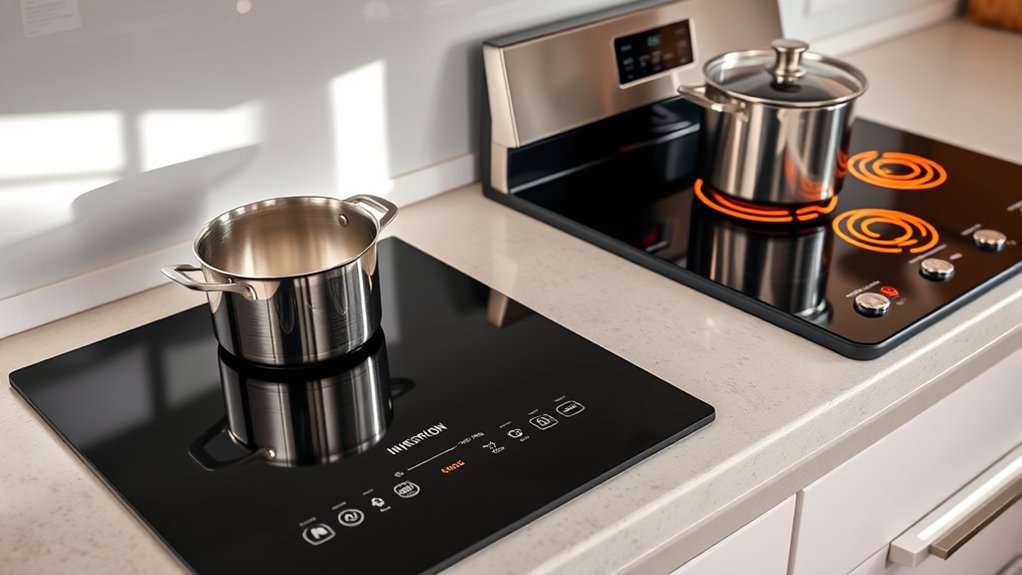
Because they use different ways to generate heat, induction and electric cooktops warm your food in fundamentally different ways. With induction, electromagnetic coils beneath the glass create a magnetic field that induces currents directly in ferrous cookware, so energy transfer happens straight into the pan.
Induction and electric cooktops heat differently: induction drives energy directly into ferrous pans, while electric warms the surface first.
You feel little residual warmth on the cooktop because the glass mainly heats from contact with the hot pan. This focused transfer gives you responsive control over temperature changes and minimizes wasted heat in the surrounding air.
Traditional electric ranges use resistive heating elements that heat the cooktop surface, which then warms the pan through conduction. Heat distribution depends on element design and contact quality, so you’ll sometimes notice hotspots or slower, more even warming across a wider area.
Both methods boil, sauté, and simmer effectively, but you’ll interact differently with their feedback and control. Induction reacts to your adjustments quickly, while electric relies on the element and surface to stabilize at the set level.
Speed: Which Cooks Faster-Induction or Electric?
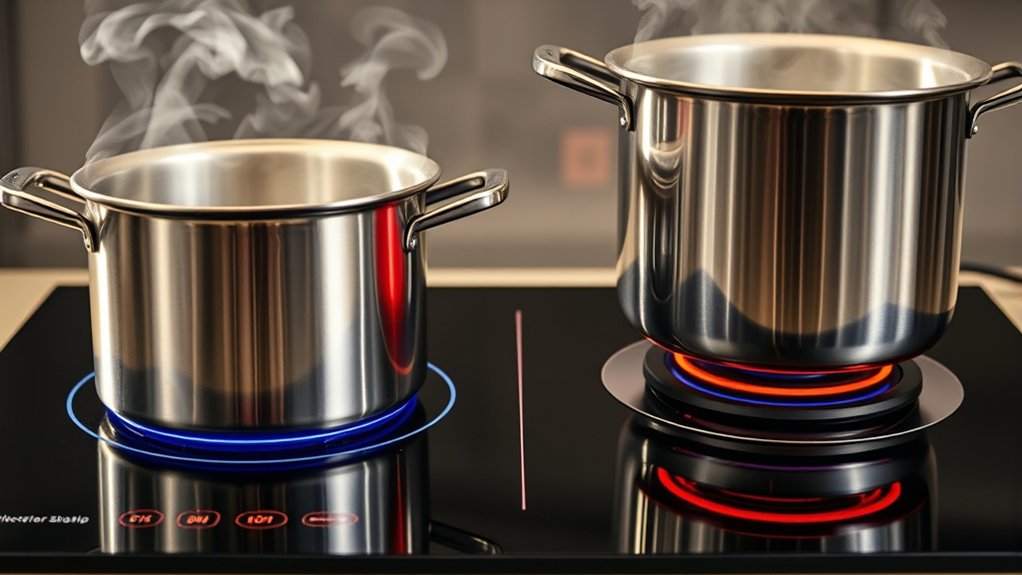
While both cooktops get the job done, induction typically brings pots to temperature far faster than traditional electric ranges because it transfers energy directly into the cookware rather than heating the surface first. You’ll notice shorter boil times and faster searing on induction, which responds instantly when you change settings.
That immediacy also helps with precise temperature regulation, so you won’t overshoot delicate sauces.
Compare practical differences:
- Faster heat-up: induction reaches target temps in seconds.
- Faster cooldown: heat drops immediately when you lower power.
- Responsive adjustments: you’ll get near-instant changes to simmer or boil.
- Even cooking: direct energy transfer reduces hotspots in suitable pans.
- Power consistency: induction maintains steady output across settings.
If you value quick weeknight meals or tight control during complex recipes, induction gives you a clear edge.
Traditional electric can be steady for long, low-heat tasks, but it won’t match the speed and responsiveness of induction.
Energy Efficiency & Operating Costs for Both Ranges
You’ll want to compare how much energy each range uses during typical cooking sessions. A more efficient model can lower your electricity bills over time, but the purchase price and maintenance costs matter, too. Let’s look at real-world energy use and lifetime operating expenses to determine which option offers the better value.
Energy Use Comparison
When you compare induction and electric coil or smooth-top ranges, the biggest energy difference comes down to how heat is transferred. Induction heats the pan directly, improving power efficiency and reducing wasted heat in the kitchen.
That means faster boiling and less standby loss.
- Induction delivers energy to cookware via magnetic fields, so less heat escapes.
- Electric coils heat the element, then the pan, losing more energy.
- Smooth-top ranges trap some heat under the glass, lowering immediate transfer.
- Induction responds faster to control changes, saving brief bursts of power.
- For similar tasks, induction typically uses less electricity per cook cycle.
These differences impact daily energy use but not long-term cost analysis here.
Long-Term Cost
1 key factor in long-term cost is how much energy your range actually uses over years of cooking, since that determines recurring electricity bills and, indirectly, appliance wear. You’ll often find induction models cost more upfront but save on operating costs thanks to higher efficiency and faster heat transfer.
That efficiency also reduces wear because cook times are shorter, supporting induction durability. Traditional electric ranges usually cost less to buy and work with any cookware thanks to electric compatibility, but they waste more heat and can raise monthly bills.
Consider how often you cook, local electricity rates, and expected lifespan. A higher initial investment in induction can pay off over time, while electric may be cheaper short-term but pricier to run.
Temperature Control and Cooking Precision Compared
Though both cooktops heat food, induction gives you far tighter temperature control and faster, more predictable responses than electric ranges do. You’ll notice superior temperature stability and better cooking consistency with induction.
It adjusts power almost instantly, so sauces won’t break and chocolate won’t seize as easily. Electric ranges rely on heated coils or glass elements that lag, causing wider temperature swings and slower corrections.
You get more precise simmering, searing, and rapid boil control with induction, which translates to repeatable results when you follow recipes. That matters when you want professional-level outcomes without guessing.
- Immediate heat changes for quick corrections
- Finer low-heat control for delicate tasks
- Consistent surface temperatures across cycles
- Faster time-to-temperature for efficient cooking
- Predictable results that reduce trial-and-error
Safety Risks and Built‑In Safety Features
Better temperature control also changes the safety profile you’ll deal with in the kitchen: because induction responds instantly and keeps surface temps lower, it reduces burn and fire risks compared with traditional electric ranges that hold heat and swing unpredictably. You’ll notice induction’s cooktop cools quickly after you remove cookware, lowering scald and ignition hazards.
Induction’s instant response and lower surface temps cut burn and fire risks, cooling quickly after cookware is removed.
Many induction units include automatic shutoff if no pan is detected, minimizing accidental activation and wasted energy.
With electric coil or smooth-top ranges, residual heat indicators help, but the surface can still stay dangerously hot and mask ongoing elements.
Both systems increasingly offer child safety locks and control-panel timeouts to prevent curious hands from turning elements on. You should also check for tip-over protection in ranges and for anti-slip feet on slide-in models.
Ultimately, choose a range whose safety features match your household: if you have kids or mobility concerns, prioritize child safety locks, clear heat indicators, and automatic shutoff to reduce everyday risks.
Cookware Needs: What Works on Induction vs Electric
When you switch to induction, you’ll need cookware that’s magnetic and flat-bottomed so the cooktop can sense and heat it efficiently. You’ll also want to think about cookware compatibility across your current pots and pans and how their aesthetic design fits your kitchen. Induction demands ferrous-base materials; electric ranges will work with almost anything but may heat less evenly.
- Cast iron: excellent magnetic response and heat retention.
- Stainless steel (with magnetic base): versatile and often sleek in aesthetic design.
- Carbon steel: lightweight, responsive, and induction-friendly.
- Aluminum/copper: require a magnetic base layer to work on induction.
- Glass/ceramic: fine for electric, but won’t work on induction without a magnetic plate.
You can test compatibility with a magnet: if it sticks, the cookware will work on induction. If you’re replacing cookware, prioritize pieces that match both your performance needs and the kitchen look you want, rather than buying unnecessarily.
Installation, Repair, and Long‑Term Maintenance Costs
If you’re installing a new range, plan for different upfront and ongoing costs depending on whether you choose induction or electric. Installation for induction can be pricier if you need a dedicated 240V circuit or countertop modifications; electric often fits existing wiring.
Repairs for induction are more specialized and may cost more, while electric coil or radiant repairs are usually simpler and cheaper. Warranty coverage and brand reputation affect long-term costs. Strong warranties and reputable brands can offset higher repair bills.
| Cost Area | Induction | Electric |
|---|---|---|
| Installation | Higher if rewiring/cutting | Lower if existing circuit works |
| Repair | More expensive, specialist techs | Generally cheaper, common parts |
| Maintenance | Minimal surface care; potential electronics cost | Minimal electronics; element replacements cheaper |
Factor in expected lifespan, service network, and whether your preferred brands offer extended warranties. That way you’ll estimate true lifetime cost, not just the sticker price.
Everyday Usability: Cleaning, Noise, and Surface Layout
When comparing induction and electric ranges, start with cleanup. Spills usually wipe off the smooth induction surface easily, while electric coils and some ceramic tops can be more difficult to clean.
Noise is another factor to consider. Induction cooktops may produce a hum or fan noise, especially when you’re cooking at high power. Electric elements are often quieter, with only the usual sounds of heating and cooling.
Finally, think about how much flexibility you want in the cooktop layout. Many induction models offer bridgeable zones and more precise cookware placement, while electric layouts can be more fixed and limiting.
Surface Cleaning Ease
Although both induction and electric ranges look similar at first glance, their everyday surface cleaning, noise, and layout make a big practical difference you’ll notice each time you cook. You’ll find induction tops are flatter and cool faster, so surface stains from spills don’t bake on as badly, and cleaning techniques are simpler. Electric coil or radiant elements can trap grime around edges, needing more elbow grease and tools.
- Wipe spills on induction while still warm for easy removal.
- Use a scraper carefully on ceramic electric glass after cooling.
- Coils require lifting and brushing beneath for thorough cleaning.
- Gaskets and seams on older electrics collect crumbs.
- Choose induction if you prefer quick, low-maintenance wipe-downs.
Operational Noise Levels
How loud is your kitchen going to be while you cook? You’ll notice induction ranges often produce low operational noise from fans and occasional buzzing as coils modulate power. That hum is usually under everyday sound levels, so it won’t compete with conversation or media.
Electric coil or smooth-top electric ranges can be quieter when idle but may emit clicking and fan noise during broiling or oven cycles, raising perceived sound levels intermittently. If you’re sensitive to noise, check manufacturer decibel specs and read user reviews to compare real-world operational noise.
Also consider placement: a range with higher fan speeds or vibration-transferring mounts will seem louder. Choose the option whose documented and reported sound levels match your tolerance.
Cooktop Layout Flexibility
Noise levels matter, but you’ll also want to think about how the cooktop’s layout affects everyday use: cleaning, noise interaction, and where you place cookware.
You’ll notice induction often uses flexible burners and smooth glass for quick wipe-downs, while electric coil or radiant tops can trap grime and rattle more.
A modular design on some induction models lets you reconfigure zones for griddles or large pots, reducing clutter and overlapping sounds.
Consider how heat distribution and spacing change cleaning patterns and where pans sit during noisy burners.
- Flexible burners let you fit varied cookware sizes without shifting pans.
- Modular design enables custom zones for different tasks.
- Smooth surfaces simplify wiping spills.
- Spacing affects splatter control.
- Zone indicators reduce accidental touching.
Final Recommendation: Which Range Suits Your Cooking Style
When picking between an induction and an electric range, think about how you cook, what you value most (speed, control, or simplicity), and your kitchen’s electrical setup. This helps you choose the one that fits your routine and budget.
If you prioritize fast heat and precise control, induction’s responsive cooking surface and cookware compatibility make it ideal. You’ll need magnetic pans, but you’ll gain efficiency and safety.
If you prefer low cost, simple maintenance, and wide cookware acceptance, a traditional electric range may suit you.
| Best For | Why |
|---|---|
| Speed & Precision | Induction: instant heat, exact control |
| Simplicity & Cost | Electric: cheaper, works with any pan |
| Safety & Efficiency | Induction: cooler surface, less wasted energy |
Decide by matching features to your habits, whether you make quick weekday meals, practice serious precision cooking, or use your range occasionally on a budget.
Choose the range that fits your daily cooking patterns and long-term priorities.
Frequently Asked Questions
Do Induction Ranges Affect Pacemakers or Other Medical Devices?
Yes, induction ranges can interfere with some pacemakers and implantable devices, so you should take safety precautions. Manufacturers and cardiologists generally say modern pacemakers are well shielded, but you should not lean over an active cooktop or carry a phone between your device and the stove.
Keep your distance, follow device-specific guidance, and consult your clinician if you are concerned. They can confirm safe use and recommend any additional precautions for your particular medical device.
Can Induction or Electric Ranges Be Used During Power Outages?
No, you can’t use induction or electric ranges during power outages unless you have a powered backup. You’d need a generator or battery system to run them.
Induction offers faster cooking speed and higher energy efficiency when power’s on, so with a portable power source it cooks quicker and wastes less energy. Otherwise, you’ll need gas, a camp stove, or cold food until electricity’s restored.
Which Range Type Has Better Resale Value for Homes?
Induction ranges generally boost resale value more and make a stronger home investment. Buyers often see induction as modern, efficient, and desirable, so you’ll likely recoup more at sale.
Electric ranges still sell fine, especially in budget homes, but they don’t command the same premium. If you’re upgrading to maximize appeal and long-term return, choose induction for a clearer positive impact on your property’s marketability.
Are There Special Warranties or Service Plans for Induction Vs Electric?
About 65% of appliance owners prefer extended coverage, so yes—you’ll find different warranty options and service plans for induction vs electric. You’ll get standard manufacturer warranties, but induction ranges often carry specialized electronic and coil coverage and sometimes longer labor terms.
You can buy third-party service plans that cover parts, labor, and accidental damage. Compare term lengths, transferability, and in-home repair clauses before you commit.
Do Either Range Types Interfere With Nearby Electronics or Wi‑Fi?
Yes, but rarely. You won’t notice interference from electric coils or smooth-top resistive ranges; they don’t emit the high-frequency fields that induction ranges do.
Induction ranges can produce localized electromagnetic fields, but modern units meet safety standards and usually won’t disrupt Wi-Fi or nearby electronics if you follow the manufacturer’s guidelines.
For kitchen safety and energy efficiency, keep sensitive devices a reasonable distance away. Use proper grounding and certified service to avoid issues and maintain performance.
Conclusion
You’ll likely prefer induction if you want speed and precision. Induction boils water about 50% faster than conventional electric, while electric works if you want lower upfront cost and compatibility with any cookware.
Consider energy savings, cooktop cleaning, and maintenance needs alongside your budget and cooking habits. If you value instant heat, safer surfaces, and finer temperature control, choose induction; if you favor simplicity and lower initial expense, stick with an electric range.
In conclusion, choosing between an induction vs electric range depends on your priorities. Choose induction for efficiency and control, or electric for affordability and cookware flexibility.